Preparations for the polls will begin next week, but some political observers are worried a recent presidential decision could make dissolution more likely
A new date for Egypt's long-delayed parliamentary elections is expected to be announced next week, a minister has said, after a ceremony marking the opening of a new Suez Canal channel is held on Thursday.
The elections were originally scheduled for March, but the Supreme Constitutional Court ruled that the law regulating electoral districts was unconstitutional.
The Minister of Parliamentary Affairs and Transitional Justice, Ibrahim El-Heneidy, told reporters on Saturday that he expects that the seven-member Supreme Elections Committee (SEC), which is in charge of supervising Egypt's parliamentary elections, to announce a timetable for the long-delayed polls.
“President Abdel-Fattah El-Sisi has at last ratified the two remaining laws necessary to pave the way for the polls," said El-Heneidy, stressing that "the government and president's roles regarding the polls have now finished and from now on it is the SEC's turn to take responsibility for the next stage of the election process."
"I expect that the detailed timeline of the polls will be announced next week, and we are keen as government officials not to intervene in these polls in any way," said the minister.
El-Heneidy said that the two electoral laws ratified by El-Sisi on Saturday concern the exercise of political rights and the affairs of the House of Representatives.
El-Heneidy indicated that the political rights law was amended to state that a list of 15 party-based candidates cannot spend more than LE2.5 million on election campaigns.
"In case of a run-off round, the amount will be reduced to LE1 million," said El-Heneidy.
The law also states that a list of 45 party-based candidates cannot spend more than LE7.5 million in campaigning costs, and in case of a run-off vote the amount will be reduced to LE3 million.
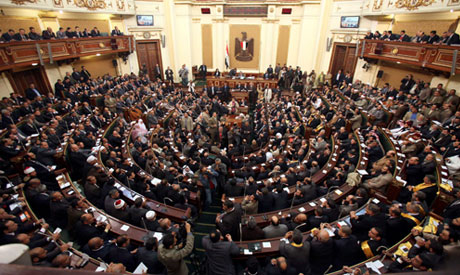
Speaking about the House of Representatives law, El-Heneidy said that it states that Egypt's coming parliament will comprise 568 elected MPs, with 448 elected as independents and 120 elected via party lists.
Five percent of the house, or 28 MPs, will be appointed directly by the president, bringing the total number of representatives to 596, El-Heneidy said.
The Supreme Elections Committee (SEC) began on Saturday accepting applications from civil society organisations and media outlets wishing to obtain permits to cover the polls.
According to the SEC's spokesman Omar Marawan, the outlets and organisations seeking permits will be able to register with the committee from 21 to 25 August, while the permits will be given out from 26 to 30 August.
Marawan told reporters that the committee's decision regarding the schedule for media permits was the first concrete step paving the way for parliamentary elections.
"I can say that the wheels of Egypt's parliamentary elections have at last begun moving," said Marawan.
Marawan also indicated that the ratification of the two remaining laws on parliamentary elections will help speed things up.
"As President Abdel-Fattah El-Sisi has ratified the amendments to the two remaining laws on parliamentary elections -- the law on the exercise of political rights ([aw no.45 of 2014], and the law on the House of Representatives [law no.46 of 2014]-- I agree that the Supreme Elections Committee will be now fully entitled to set a detailed timeline for the polls," said Marawan.
The spokesman said that El-Sisi had last month ratified the amendments to two other significant laws related to the elections, the law on the division of electoral constituencies (law no. 202 of 2014) and the law on the performance of the Supreme Constitutional Court (law no. 48 of 1979). These amendments were “very important preliminary steps on the road to the polls," said Marawan.
In a speech to graduating students from a number of military academies on Thursday, President El-Sisi stressed that Egypt will have a new parliament before the end of this year. "This shows we are committed to achieving the goals of democracy, freedom, justice, and equality for all," El-Sisi said.
Political analysts and activists interviewed said they hope El-Sisi's words on democracy aren't just lip service.
Anwar El-Sadat, chairman of the liberal Reform and Development Party, told : "El-Sisi vowed several times that parliamentary elections would be held soon, but these promises have not yet come true."
"We know that legal and constitutional obstacles have prevented parliamentary elections from being held for more than a year, but now with all obstacles eliminated, we hope the polls will kick off very soon," said El-Sadat.
He warned, however, that El-Sisi's decision on 28 July to repeal a law obliging the Supreme Constitutional Court to issue rulings on complaints against election laws within a tight deadline could be a double-edged weapon.
"This decision could be catastrophic, because it puts the coming parliament at the mercy of the Supreme Constitutional Court," said El-Sadat, noting that the court “had previously ordered that Egypt's 2012 Islamist-dominated parliament be dissolved upon the grounds that its election law violated the constitution,” and that El-Sisi's decision could make this scenario a possibility once more.
"This is true as long as the Supreme Constitutional Court has now become free to issue rulings on election laws at any time," said El-Sadat.
The politician, however, said that although potentially problematic, the decision "was the inevitable option at this moment, in order to pave the way for parliamentary elections to be held in the shortest possible time."
"El-Sisi's decision on 28 July was issued to stem the tide of constitutional challenges which aimed to delay parliamentary elections permanently," argued El-Sadat.
He stressed that, once elected, the coming parliament should move quickly to safeguard itself from any possible threats of dissolution. "MPs could change the Supreme Constitutional Court law so that its rulings on election laws do not have an immediate effect on parliament, or at least let parliament complete its term [after a ruling] without being dissolved at once," he said.
Shawki El-Sayed, a prominent election appeals lawyer and a former independent member of the Shura Council, argued that: "obliging the Supreme Constitutional Court to issue rulings on complaints against election laws within a short timeframe exerted a lot of pressure on its judges and as a result they urged El-Sisi to cancel a decree issued early last year by former interim president Adly Mansour, now the Supreme Constitutional Court's chairman, to free themselves from any time limits."
El-Sayed explained that complaints filed with the Supreme Constitutional Court are confined to election laws only and the court's job is to see whether these contravene the constitution or not.
"As for the complaints and appeals on the election process itself, such as contesting the legality of a certain candidate, these will have to be filed before the Supreme Elections Committee, which is exclusively mandated with supervising the election process," said El-Sayed.
He explained that there is a third kind of election appeal – those that are “filed against the election results, and these have to be decided by the Court of Cassation.”
Minister of Parliamentary Affairs and Transitional Justice Ibrahim El-Heneidy explained that the law governing the affairs of the Supreme Constitutional Court was amended by interim president Adly Mansour in early 2014 (decree no. 26 of 2014) to oblige the court to issue rulings on appeals against election laws within five days of receiving the appeal, but El-Sisi's amendment will allow the court to decide on these appeals without any time limit.
El-Heneidy indicated that the amendment was proposed by the court's board itself. "Its judges, headed by former interim president Adly Mansour, complained that the time limit on election law appeals placed a tremendous burden on them and that they do not want to be restricted by any time limits in looking into these complaints," said El-Heneidy.
Amr Hashem Rabie, a political analyst, warned that although El-Sisi's decision might safeguard election laws against constitutional challenges in the short run, it could pose a serious threat to parliament in the long run.
"I agree that the scenario of 2012's parliament could happen again, because if any election law was ruled unconstitutional after parliament was elected, parliament would be dissolved automatically," said Rabie.
By contrast, Shehab Wagih, spokesman of the Free Egyptians Party, heaped praise on El-Sisi's decision, arguing that: "it will help prevent those fond of filing appeals against election laws from pursuing this ruinous adventure."
"But I do not think that this will be a threat to parliament in the long run because we believe that all the recent amendments of the election laws are in line with the constitution, and hence there will be no grounds for any possible dissolution," said Wagih.
El-Sayed said that he believes that "in issuing rulings on complaints against election laws in the future, the Supreme Constitutional Court's board will be keen not to destabilise any of the state's authorities."
Besides, said El-Sayed, "I see that most political parties have refrained from contesting the constitutionality of the amended election laws and as a result this issue will not become a thorn in the side of the coming parliament."
In June 2012, just five months into its term, the Islamist-dominated parliament was ordered to be dissolved by the Supreme Constitutional Court, on the grounds that the election law by which the MPs were elected discriminated against independent candidates.
El-Heneidy disclosed that an earlier legislative proposal aimed at making the coming parliament immune to dissolution was rejected.
"The proposal, submitted by some political parties, stipulated that if a parliamentary election law was ruled unconstitutional, this should not lead to an automatic or immediate dissolution of parliament," said El-Heneidy, adding that, "this proposal was rejected by the cabinet last month."
El-Sadat argued the parties' proposal that the coming parliament not be dissolved at once should an election law be invalidated was aimed at stabilizing the country's political and legislative life and helping Egypt move forward along the road of democracy.