Free Web Submission http://addurl.nu FreeWebSubmission.com Software Directory www britain directory com education Visit Timeshares Earn free bitcoin http://www.visitorsdetails.com CAPTAIN TAREK DREAM: Discovery

Showing posts with label Discovery. Show all posts

Friday, April 24, 2020

A valuable new archaeological discovery in Egypt إكتشاف أثري جديد ثمين في مصر


توصلت البعثة الأثرية المصرية-الإسبانية العاملة في منطقة ذراع أبو النجا بالأقصر، جنوب البلاد، إلى اكتشاف تابوت خشبي من الأسرة السابعة عشر عند الفراعنة، وتعود لسنة 1600 قبل الميلاد.

The Egyptian-Spanish archaeological mission operating in the arm of Abu al-Naga in Luxor, in the south of the country, has discovered a wooden coffin from the seventeenth family at the Pharaohs, and dates back to the year 1600 BC.


وقال  الأمين العام للمجلس الأعلى للآثار في مصر، مصطفى وزيري، إن الموسم التاسع عشر لأعمال البعثة بدأ في 2020 أمام الفناء المفتوح للمقبرة رقم TT 11  للمدعو "جحوتي"، وقد تم العثور على التابوت بالقرب من مقصورة مصنوعة من الطوب، وبجواره العديد من الأثاث الجنائزية. 

The Secretary-General of the Supreme Council of Antiquities in Egypt, Mostafa Waziri, said that the nineteenth season of the mission's work began in 2020 in front of the open courtyard of tomb No. TT 11 called "Jahouti". The sarcophagus was found near a brick cabin, and several funeral furniture were found next to it.
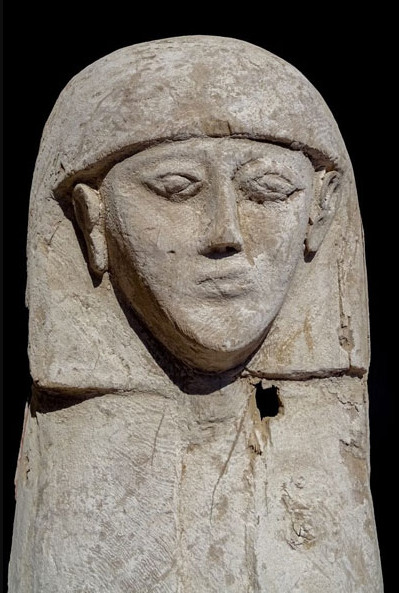

ويبلغ مقاس التابوت 1.75م في 0.33 م، وتم صنعه من الخشب من قطعة واحدة من شجر الجميز، وتم طلائه بطبقة من الملاط الأبيض، بينما تم طلائه من الداخل باللون الأحمر.

The sarcophagus measures 1.75 m by 0.33 m, and was made of wood from a single piece of sycamore tree, and was coated with a layer of white mortar, while the interior was painted in red.


وفي داخل التابوت، عثر على مومياء لفتاة تبلغ من العمر 15 أو 16 سنة، ملقاة على جنبها الأيمن، في حالة سيئة من الحفظ، ترتدي حلقتين في أحد أذنيها بشكل حلزوني ومغلفة بورقة معدنية رقيقة، وقد تكون نحاسية. 

Inside the coffin, a mummy was found for a 15- or 16-year-old girl, lying on her right side, in a poor state of conservation. She wore two rings in one of her ears in a spiral shape and was wrapped in a thin, possibly copper-plated sheet.


وأضاف  رئيس الإدارة المركزية لآثار مصر العليا، محمد عبد البديع، أن البعثة عثرت على 4 قلادات مربوطة ببعضها البعض بمشبك خزفي على صدر المومياء؛ القلادة الأولى يبلغ طولها 70 سم، وهي تتكون من خرز دائري مزخرف باللون الأزرق الداكن والفاتح.

The head of the Central Department of Upper Egypt Antiquities, Mohamed Abdel-Badi, added that the mission found 4 necklaces bound together with a ceramic clip on the mummy chest; the first necklace is 70 cm long, and it consists of circular beads decorated in dark blue and light.


أما القلادة  الثانية فيبلغ طولها 62 سم، وهي مصنوعة من القيشاني الأخضر والخرز الزجاجي، أما القلادة الثالثة فهي الأكثر جمالا 
ويبلغ طولها 61 سم، وهي مصنوعة من 74 قطعة تجمع بين حبات الامتيست والكورنيلي والكهرمان والزجاج الأزرق والكوارتز.

The second necklace is 62 cm in length and is made of faience green and glass beads. The third necklace is the most beautiful and has a length of 61 cm. It is made of 74 pieces that combine amethyst, corneli, amber, blue glass, and quartz beads.


كما تحتوي على جعرانين، واحد منهما علي هيئة الإله حورس، و 5 تمائم من القيشاني، وتتكون القلادة الرابعة من عدة سلاسل من خرز القيشاني مرتبطة ببعضها البعض بحلقة تجمع بين جميع الخيوط.

It also contains two scarabs, one in the form of the god Horus, and 5 amulets from faience, and the fourth necklace consists of several chains of faience beads bound together by a ring that combines all threads.

وفي الجانب الآخر من المقصورة تم العثور على تابوت صغير مصنوع من الطين، مغلقا ومربوطا بسلسلة، بداخله 4 تمثيال أوشابتي خشبية ملفوفة بلفائف كتانية، مكتوب على أحدهما كتابة هيراطقية تحدد أسم صاحبه "أوزيريس جحوتي"، الذي عاش في الأسرة السابعة عشر (حوالي 1600 قبل الميلاد).

On the other side of the cabin, a small sarcophagus was found, enclosed and bound by a chain, inside which there are 4 wooden ochbeat representations wrapped in linen scrolls, written on one of them a hieratic script that identifies the name of its owner, Osiris Jahouti, who lived in the seventeenth family (circa 1600 BC).


وأشار رئيس البعثة الدكتور جالان، إلى أن البعثة توصلت أيضا في نفس المنطقة، إلى بئر للدفن بداخله زوج من الصنادل الجلدية مصبوغة باللون الأحمر الزاهي، وزوج من الكرات الجلدية مربوطة ببعضها البعض بخيوط، تعود إلى الأسرة السابعة عشر، وزوج من القطط، ووعل ووردة . جميعهم في حالة جيدة من الحفظ.

The head of the mission, Dr. Jalan, indicated that the mission also reached a burial well inside a pair of leather sandals dyed in bright red, a pair of leather balls tied to each other with threads, belonging to the seventeenth family, and a pair of cats, a caribou and a rose. all of them In good condition.


ومن المرجح أن تلك الأشياء تخص امرأة كانت تستخدمهم للرياضة أو كجزء من الرقص، وذلك وفقا لتصويرات الحياة اليومية في مقابر بني حسن من الأسرة الثانية عشرة.

It is likely that these things belonged to a woman who was using them for sports or as part of dancing, according to the depictions of daily life in the tombs of Bani Hassan of the Twelfth Dynasty.

Monday, September 23, 2013

Exclusive: Creating electricity with caged atoms

Creating electricity with caged atoms

Clathrates: Tiny cages enclosing single atoms are shown

Clathrates are crystals consisting of tiny cages in which single atoms can be enclosed. These atoms significantly alter the material properties of the crystal. By trapping cerium atoms in a clathrate, scientists at the Vienna University of Technology have created a material which has extremely strong thermoelectric properties. It can be used to turn waste heat into electricity.

A lot of energy is wasted when machines turn hot, unnecessarily heating up their environment. Some of this thermal energy could be harvested using thermoelectric materials; they create electric current when they are used to bridge hot and cold objects. At the Vienna University of Technology (TU Vienna), a new and considerably more efficient class of thermoelectric materials can now be produced. It is the material's very special crystal structure that does the trick, in connection with an astonishing new physical effect; in countless tiny cages within the crystal, cerium atoms are enclosed. These trapped magnetic atoms are constantly rattling the bars of their cage, and this rattling seems to be responsible for the material's exceptionally favourable properties.

Cerium Cages from the Mirror Oven

"Clathrates" is the technical term for crystals, in which host atoms are enclosed in cage-like spaces. "These clathrates show remarkable thermal properties", says Professor Silke Bühler-Paschen (TU Vienna). The exact behaviour of the material depends on the interaction between the trapped atoms and the cage surrounding them. "We came up with the idea to trap cerium atoms, because their magnetic properties promised particularly interesting kinds of interaction", explains Bühler-Paschen.

For a long time, this task seemed impossible. All earlier attempts to incorporate magnetic atoms such as the rare-earth metal cerium into the clathrate structures failed. With the help of a sophisticated crystal growth technique in a mirror oven, Professor Andrey Prokofiev (TU Vienna) has now succeeded in creating clathrates made of barium, silicon and gold, encapsulating single cerium atoms.

Creating electricity with caged atoms

This is the Mirror Oven at the Vienna University of Technology, in which the novel material was created

Electricity from Temperature Differences

The thermoelectric properties of the novel material have been tested. Thermoelectrics work when they connect something hot with something cold: "The thermal motion of the electrons in the material depends on the temperature", explains Bühler-Paschen. "On the hot side, there is more thermal motion than on the cold side, so the electrons diffuse towards the colder region. Therefore, a voltage is created between the two sides of the thermoelectric material."

Experiments show that the cerium atoms increase the material's thermopower by 50%, so a much higher voltage can be obtained. Furthermore, the thermal conductivity of clathrates is very low. This is also important, because otherwise the temperatures on either side would equilibrate, and no voltage would remain.

The World's Hottest Kondo Effect

"The reason for these remarkably good material properties seem to lie in a special kind of electron-electron correlation – the so-called Kondo effect", Silke Bühler-Paschen believes. The electrons of the cerium atom are quantum mechanically linked to the atoms of the crystal. Actually, the Kondo effect is known from low temperature physics, close to absolute zero temperature. But surprisingly, these quantum mechanical correlations also play an important role in the novel clathrate materials, even at a temperature of hundreds of degrees Celcius.

"The rattling of the trapped cerium atoms becomes stronger as the temperature increases", says Bühler-Paschen. "This rattling stabilizes the Kondo effect at high temperatures. We are observing the world's hottest Kondo effect."

More Research for Better and Cheaper Clathrates

The research team at TU Vienna will now try to achieve this effect also with different kinds of clathrates. In order to make the material commercially more attractive, the expensive gold could possibly be substituted by other metals, such as copper. Instead of cerium, a cheaper mixture of several rare-earth elements could be used. There are high hopes that such designer clathrates can be technologically applied in the future, to turn industrial waste heat into valuable electrical energy.

EXCLUSIVE : Scientists explain the formation of unusual ring of radiation in space


Since the discovery of the Van Allen radiation belts in 1958, space scientists have believed these belts encircling the Earth consist of two doughnut-shaped rings of highly charged particles—an inner ring of high-energy electrons and energetic positive ions and an outer ring of high-energy electrons.

In February of this year, a team of scientists reported the surprising discovery of a previously unknown third radiation ring—a narrow one that briefly appeared between the inner and outer rings in September 2012 and persisted for a month.

In new research, UCLA space scientists have successfully modeled and explained the unprecedented behavior of this third ring, showing that the extremely energetic particles that made up this ring, known as ultra-relativistic electrons, are driven by very different physics than typically observed Van Allen radiation belt particles. The region the belts occupy—ranging from about 1,000 to 50,000 kilometers above the Earth's surface—is filled with electrons so energetic they move close to the speed of light.

"In the past, scientists thought that all the electrons in the radiation belts around the Earth obeyed the same physics," said Yuri Shprits, a research geophysicist with the UCLA Department of Earth and Space Sciences. "We are finding now that radiation belts consist of different populations that are driven by very different physical processes."

Shprits, who is also an associate professor at Russia's Skolkovo Institute of Science and Technology, a new university co-organized by MIT, led the study, which is published Sept. 22 in the journal Nature Physics.
The Van Allen belts can pose a severe danger to satellites and spacecraft, with hazards ranging from minor anomalies to the complete failure of critical satellites. A better understanding of the radiation in space is instrumental to protecting people and equipment, Shprits said.

Ultra-relativistic electrons—which made up the third ring and are present in both the outer and inner belts—are especially hazardous and can penetrate through the shielding of the most protected and most valuable satellites in space, noted Shprits and Adam Kellerman, a staff research associate in Shprits' group.

"Their velocity is very close to the speed of light, and the energy of their motion is several times larger than the energy contained in their mass when they are at rest," Kellerman said. "The distinction between the behavior of the ultra-relativistic electrons and those at lower energies was key to this study." Shprits and his team found that on Sept. 1, 2012, plasma waves produced by ions that do not typically affect energetic electrons "whipped out ultra-relativistic electrons in the outer belt almost down to the inner edge of the outer belt." Only a narrow ring of ultra-relativistic electrons survived this storm. This remnant formed the third ring.
After the storm, a cold bubble of plasma around the Earth expanded to protect the particles in the narrow ring from ion waves, allowing the ring to persist. Shprits' group also found that very low-frequency electromagnetic pulsations that were thought to be dominant in accelerating and losing radiation belt electrons did not influence the ultra-relativistic electrons.

The Van Allen radiation belts "can no longer be considered as one consistent mass of electrons. They behave according to their energies and react in various ways to the disturbances in space," said Shprits, who was honored by President Obama last July with a Presidential Early Career Award for Scientists and Engineers.

"Ultra-relativistic particles move very fast and cannot be at the right frequency with waves when they are close to the equatorial plane," said Ksenia Orlova, a UCLA postdoctoral scholar in Shprits' group who is funded by NASA's Jack Eddy Fellowship. "This is the main reason the acceleration and scattering into the atmosphere of ultra-relativistic electrons by these waves is less efficient."

"This study shows that completely different populations of particles exist in space that change on different timescales, are driven by different physics and show very different spatial structures," Shprits said.

The team performed simulations with a model of the Earth's radiation belts for the period from late August 2012 to early October 2012. The simulation, conducted using the physics of ultra-relativistic electrons and space weather conditions monitored by ground stations, matched the observations from NASA's Van Allen Probes mission extraordinarily well, confirming the team's theory about the new ring.

"We have a remarkable agreement between our model and observations, both encompassing a wide range of energies," said Dmitriy Subbotin, a former graduate student of Shprits and current UCLA staff research associate.

"I believe that, with this study, we have uncovered the tip of the iceberg," Shprits said. "We still need to fully understand how these electrons are accelerated, where they originate and how the dynamics of the belts is different for different storms."

The Earth's radiation belts were discovered in 1958 by Explorer I, the first U.S. satellite that traveled to space.