Free Web Submission http://addurl.nu FreeWebSubmission.com Software Directory www britain directory com education Visit Timeshares Earn free bitcoin http://www.visitorsdetails.com CAPTAIN TAREK DREAM: Libya

Showing posts with label Libya. Show all posts

Wednesday, July 15, 2015

Egypt's Sisi and Italian FM vow to continue 'strong cooperation against terrorism

Sisi-Italian

Egyptian president Abdel Fattah El-Sisi meeting with Italian Foreign minister on July 13, 2015

Egyptian President Abdel Fattah El-Sisi discussed on Monday with Italian Foreign Minister Paolo Gentiloni means of combatting terrorism, issues related to the Libyan crisis and solutions for the increasing numbers of illegal immigrants into Europe, the Egyptian presidency said.

Gentiloni arrived in Cairo on Monday for a one-day to visit to meet with El-Sisi and Egyptian Foreign Minister Sameh Shoukri two days after a car bomb attack against the Italian consulate in Cairo.

The Saturday morning attack destroyed parts of the consulate's facade, and left an Egyptian street vendor dead and ten others injured.

The Italian FM told the Egyptian president that his country sees the terrorist attack on the Italian consulate as a "failed attempt" to weaken the strong ties that bind Rome and Cairo, the Egyptian presidency's spokesperson said in a statement on Monday evening.

El-Sisi expressed to Gentiloni Egypt's appreciation for Italy's support to the country's effort to combat terrorism.

The Egyptian president stressed to the Italian FM that the "terrorist groups" have not only been operating in Egypt but also in foreign countries.

He also stressed in  the meeting the importance of international cooperation to face the threat of terrorism, saying that terrorist groups coordinate internationally on an ideological and logistical level.

The spokesperson added that El-Sisi warned of dire consequences resulting from the deterioration of security conditions in Libya.

Rebel Libyan militias have been fighting the internationally recognised central government in Tobrouk in a civil war that has ravaged the country.

El-Sisi called on the international community to heed Egypt's plea for world leaders to lend urgent support to the Libyan army's efforts to stop the flow of money, arms and foreign fighters into Libyan territories.

The Egyptian president and the Italian FM also discussed issues related to illegal immigration from North Africa across the Mediterranean.

Monday, April 20, 2015

#EU told to act over #migrant horror in #Mediterranean


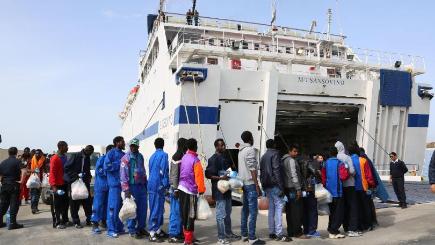
Rescuers help children to disembark in the Sicilian harbor of Pozzallo, Italy, early Monday, April 20, 2015


European Union ministers headed into crisis talks Monday under pressure to act over people smuggling as Italian and Maltese authorities grappled with the grim aftermath of the Mediterranean's deadliest migrant disaster.


More than 700 people are feared dead following Sunday's capsize off Libya of a fishing boat that had been crammed with migrants trying to reach Europe.


One survivor has told Italian authorities that there were as many as 950 people on board and that some of them had been locked below deck by the smugglers.


Italian and Maltese navy boats continued to scour waters off Libya as a first group of survivors and 24 corpses arrived in Malta aboard an Italian coast guard vessel.


The Bruno Gregoracci docked at Boiler Wharf with 24 body bags laid out on its deck. They were then carried into waiting hearses for transfer to a morgue.


Survivors on board the ship were to be taken on to Sicily later in the day. Italian authorities say only 28 people survived the disaster, at least one of whom is already in hospital in Sicily.


Italian Prime Minister Matteo Renzi has vowed that every effort will be made to salvage the capsized boat and ensure those who perished on board are given decent burials.


Refugee and rights bodies have described the disaster as one that could have been avoided and say European governments have to beef up rescue operations and address the underlying causes of the surge in asylum-seekers and migrants trying to reach Europe.


"The world needs to react with the conviction with which it eliminated piracy off the coast of Somalia a few years ago," said Wiliam Lacy Swing, director general of the International Organization for Migration.


"All of us, especially the EU and world's powers can no longer sit on the sidelines watching while tragedy unfolds in slow motion."


Malta's Prime Minister Joseph Muscat said the EU had to address the chaos in Libya which allows smugglers to operate out of the troubled north African state with impunity. "The name of the game is Libya and the securitisation of Libya," Muscat said.


"We have what is fast becoming a failed state on our doorsteps and criminal gangs are enjoying a heyday."


EU foreign ministers were set to discuss the immigration disaster at a previously scheduled meeting in Luxembourg on Monday and will be joined by their interior ministry colleagues.


Italy has demanded an emergency summit of EU leaders be held by the end of the week.


The latest disaster comes after a week in which two other migrant shipwrecks left an estimated 450 people dead, with increasing boatloads coming from Libya as the North African country falls deeper into chaos.


If the worst fears about Sunday's tragedy are confirmed, it would take the death toll since the start of 2015 to more than 1,600.


More than 11,000 other would-be immigrants have been rescued since the middle of last week and current trends suggest last year's total of 170,000 migrants landing in Italy is likely to be exceeded in 2015.


Rights groups including Amnesty International are calling for the restoration of an Italian navy search-and-rescue operation known as Mare Nostrum which was suspended at the end of last year.


Italy scaled back the mission after failing to persuade its European partners to help meet its operating costs of nine million euros ($9.7 million) a month amid divisions over whether the mission was unintentionally encouraging migrants to attempt the crossing.


Mare Nostrum has been replaced by a much smaller EU-run operation called Triton.


UN Secretary General Ban Ki-moon said governments worldwide should show solidarity and take in more refugees, adding he was "shocked and deeply saddened" by reports of the latest shipwreck.


Governments must not only improve rescue at sea but also "ensure the right to asylum of the growing number of people worldwide fleeing war who need refuge and safe haven", Ban added.


The fishing boat capsized most likely as a result of terrified passengers stampeding to one side in their desperation to get off after coastal authorities in Italy and Malta picked up a distress signal around midnight (2200 GMT) on Saturday, when it was still in Libyan waters.


The deadliest incident prior to Sunday occurred off Malta in September 2014. An estimated 500 migrants drowned in a shipwreck caused by traffickers deliberately ramming the boat in an attempt to force the people on board onto another, smaller vessel.


In October 2013, more than 360 Africans perished when the tiny boat they were crammed onto caught fire within sight of the coast of Lampedusa in Italy.

Saturday, April 18, 2015

#Obama urges #Gulf nations to help with chaos in #Libya


President Barack Obama urged Gulf nations to help calm the chaotic political situation in Libya, saying that outside military action would not be enough to help reduce tensions in the war-ravaged North African country.

After a meeting with Italian Prime Minister Matteo Renzi at the White House on Friday , Obama said a political solution was needed in the oil-rich Mediterranean state, where two rival governments are fighting for control.

"We're going to have to encourage some of the countries inside of the Gulf who have, I think, influence over the various factions inside of Libya to be more cooperative themselves," Obama told reporters.

"In some cases, you've seen them fan the flames of military conflict, rather than try to reduce them."

Obama is set to meet with leaders from Saudi Arabia and other members of the Gulf Cooperation Council in Washington on May 13 and 14 to discuss a host of crises in the Middle East.

Obama noted Islamic State militants, who have taken over large parts of Syria and Iraq, have also been active in Libya. The United States is leading a coalition fighting the group in Iraq and Syria.

"We are consistently looking where terrorist threats might emanate, and Libya, obviously, is an area of great concern," Obama said. He compared the situation to Somalia, where Washington has carried out drone strikes against suspected al Qaeda militants.

"We will not be able to solve the problem with just a few drone strikes or a few military operations," he said, adding that he and Renzi did not discuss the possible sale of U.S. drones to Italy, which some Italian media reports had expected.

The United States, Italy and their allies must combine counterterrorism efforts with a push for a political resolution, Obama said.

"The answer ultimately is to have a government that can control its own borders and work with us. That's going to take some time," he said.

Renzi agreed it was up to the Libyans themselves. "Peace in Libya: either the tribes do this, or no one is going to do this," he said. 

Sunday, March 29, 2015

#ArabLeague final draft resolution calls for Arab joint force

Egyptian President Abdel-Fattah El-Sisi

Egyptian President Abdel-Fattah El-Sisi, center, Arab League Secretary-General Nabil Elaraby, left, and Egyptian Foreign Minister Sameh Shukri, preside over a meeting of Arab heads of state, in Sharm el Sheik, South Sinai, Egypt, Saturday, March 28, 2015

The Arab League's final draft resolution calls for establishing a Joint Arab force to counter growing security threats. However, the statement left the decision to participate in these forces to each and every country in accordance to its will.

The force will intervene to meet challenges that threaten the security and safety of any Arab League member at the request of the concerned state; a decision over which Iraq reportedly voiced reservations.

The final statement, which is expected to be issued later on Sunday, backed military operations carried out in Yemen by a Saudi-led coalition, urging the Houthi rebels to carry out "an immediate withdrawal from the capital Sanaa and government institutions and to surrender their weapons to the legitimate authorities."

The resolution stressed the need for an urgent response to Yemeni President Abd Rabbo Mansour Hadi's call for a conference in Saudi Arabia under the auspices of the Gulf Cooperation Council.

The League summit, held in the Egyptian resort city of Sharm El-Sheikh, called for Arab countries to support Palestine's budget for one year starting next April, and also supported the Palestinian Central Council's resolutions calling for a review of political, economic and security relations with Israel to put pressure on Tel Aviv to respect the signed agreements and international legitimacy resolutions.

Iraq reiterated its objection to any military intervention in any other country, and called for dialogue as a means to resolve problems. As for Lebanon, it stressed the need for any move to be based on Arab consensus.

The resolution called on Arabs to provide full political and logistic support to the legitimate government in Libya, including the national army.

Arab leaders urged the UN Security Council to quickly lift the embargo on arms imports to the Libyan government, as it is the sole legitimate authority, and to assume its responsibilities in preventing the flow of arms to terrorist groups.

The resolution called on the internationally-recognised government to exert more effort to control borders with neighboring countries, a decision over which Qatar voiced reservations. Algeria said items related to lifting the arms embargo and arming the Libyan army fall within the political context of the solution.

The summit urged the Security Council to take full responsibility for dealing with the Syrian crisis, and called for the Arab League Secretary-General to continue his contacts with the UN Secretary-General to reach a common plan of action to come to an agreement on the Syrian crisis, according to the "Geneva I Conference on Syria."

Arabs voiced their absolute backing for the United Arab Emirates sovereignty over its three islands near the Strait of Hormuz, calling on the Iranian government to enter into direct negotiations with the United Arab Emirates or to go to the International Court of Justice to find a peaceful solution to the issue of the islands occupied by Iran since 1971.

Thursday, March 26, 2015

Arabs to consider joint military force at #Egypt summit

Yemeni Foreign Minister Riad Yassin

Yemeni Foreign Minister Riad Yassin, center, arrives to the conference center for a meeting of Arab foreign ministers in Sharm el Sheik, Egypt, Thursday, March 26, 2015

Saudi-led strikes on Yemeni rebels are set to dominate an Arab summit that will consider forming a joint military force as several countries in the region teeter on the brink of collapse.

For years Arab states had contented themselves with directing proxies in regional struggles.


But advances by jihadists in Syria, Iraq and Libya, and Shiite rebels backed by Iran in Yemen, have led to growing calls for direct intervention.

Egypt, the most vocal advocate of a joint Arab force and host of his weekend's summit, has announced its support for the Saudi-led campaign in Yemen and said it would commit ground troops if needed.


Saudi Arabia said more than 10 countries, including five Gulf monarchies, had joined the coalition to prevent the fall of Yemeni President Abd-Rabbu Mansour Hadi.

The Arab League states signed a military defence pact in 1950 to counter the recently created Israel, but with the spread of jihadists the bloc's chief Nabil al-Arabi has said a new type of force is needed with a new mandate.


The long-floated idea was revived by Egyptian President Abdel Fattah El-Sisi to combat jihadists from the Islamic State group who have established a foothold in neighbouring Libya and control large parts of Iraq and Syria.

Sisi, a former army chief elected after the ouster his Islamist predecessor, ordered air strikes on jihadists in Libya following the beheading of Egyptian hostages in February.

The joint force proposal has also been thrust into the spotlight by Yemen's call for regional intervention to protect Hadi from rebels who have seized the capital and advanced on his southern stronghold.


Saudi Arabia carried out air strikes against the Houthi rebels in Yemen on Wednesday, launching an operation by a regional coalition that has received a pledge of logistical and intelligence support from Washington.

Arab League chief Arabi, who has been tasked with overseeing a report on a joint military force to present to the regional leaders, told that the summit's main focus should be the "terrorist" threat.

"The most important and what I hope will be the major concern of the summit is what to do about the unprecedented threats throughout the Arab word... (from) terrorist organisations," he said.

The two-day summit will start on Saturday in the resort town of Sharm el-Sheikh.


Sisi said in a recent interview that the proposal for a joint force was welcomed especially by Jordan, which might participate alongside Saudi Arabia, the United Arab Emirates and Kuwait.

"Each of these countries would bring a different capability," said Aaron Reese, the deputy research director at the Washington-based Institute for the Study of War.

"The Jordanians are well known for their special forces capability," he said. "The Egyptians of course have the most manpower and bases close to Libya."

Prior to the Egyptian air strikes in February, the United Arab Emirates, which shares Cairo's antipathy towards Islamists, had reportedly used Egyptian bases to launch its own air strikes in Libya.

Egypt had sought UN backing for intervention there, dismissing attempted peace talks between the rival governments in Libya as ineffective.

But Reese said shared regional interests might not be enough to overcome the many hurdles to forming a joint force.

"There is a long way to go from pledging support or even coordinating forces toward a truly joint force with a unified command," he said.

Iran, and possibly the United States, might also take umbrage, said Mohamed al-Zayat, the head of the Cairo-based National Centre for Middle East Studies.

"Iran, which is part of the crisis in Syria (by backing President Bashar Al-Assad) and gaining influence in Iraq and Yemen, could be provoked by such a force," he said.

He also questioned whether Washington "can accept a regional force that is not under its control".  

Saturday, March 14, 2015

285 Egyptians return home from conflict-stricken #Libya

Saturday's flight via EgyptAir raises the number of Egyptians returning to Cairo since mid-February to 11,163


Egyptians cross from Libya to Egypt through the Salloum land port gate

A total of 285 Egyptians landed in Cairo Saturday from conflict-stricken Libya, the last batch since Egypt launched airstrikes on Islamic State (ISIS) militant group targets in Derna.

This raises the number of Egyptians returning to Cairo since mid-February via EgyptAir flights to 11,163, As reported.

In February, Egypt launched airstrikes against IS militant positions in Libya’s Derna, in collaboration with Libya’s government. The strikes came in retaliation for the beheadings by ISIS militants of 20 Coptic Egyptians.

Since then, Egypt has drawn up evacuation plans for Egyptian citizens in Libya who wish to leave the war-torn country.

In recent statements, Egyptian Minister of Manpower Nahed Al-Ashry said no official number exists of Egyptian workers in Libya because large numbers travel illegally to the oil-rich North African country. However, she estimated the number stands between 800,000 and 900,000.

Since the 2011 toppling of dictator Muammar Gaddafi, rival militias have been fighting a weak central government across the country.

Instability in Libya earlier prompted many Egyptian workers to return to Egypt, though many others remained.

Thursday, February 19, 2015

Post Operation Derna: Prospects for Egypt's war against the ISIS group in Libya

The slaughter of 20 Egyptian workers in Libya left Cairo with minimal choices to weigh next a military response, but, now Egypt is testing international community's readiness to support its next moves

El-Sisi

The posting of a video showing the beheading 20 Egyptians at the hands of Islamic State group in Libya prompted an immediate meeting of the National Defence Council to decide how to respond. It didn’t take long.

On Monday Egyptian planes carried out air strikes on four targets, training camps and weapons depots used by the Islamic State group in Libya. This prompt reaction, though, was only the first move. It heralded the beginning of a flurry of diplomatic activity.

Egyptians officials were soon in contact with European capitals and Washington to press for coordinated international intervention in Libya to stop the spread of IS group.

"We have to work together to defeat terrorism… We abandoned the Libyan people to extremist militias," Egyptian President Abdel-Fattah El-Sisi told France's Europe 1 radio in an interview aired on Tuesday.

Cairo also plans to use the counterterrorism summit currently convened in Washington to explore "ways to combat terrorism and extremism" in the world, announced Foreign Ministry Spokesman Badr Abdel-Ati.

Expanding the battle to Libya may be resisted by some states already involved in the US-led coalition against the Islamic State. They are likely to argue that the impact of airstrikes in Syria and Iraq needs to be assessed before extending action to Libya. Nor has the UN envoy to Libya welcomed the possibility of international intervention.

Europe, though, may be more willing to become involved, at least to the extent of offering logistical support in the war on the IS group. It does not want to see a new Somalia on its southern doorstep. The UN Security Council is also due to address the crisis in Libya very soon.

Cairo is already formulating a roadmap for confronting terror, something El-Sisi hinted at in statements to French press.

He stressed the importance of "drying up of the sources of financing for terror in Libya and halting arms supplies to extremist groups." Terrorists, he added, must be denied a "safe haven" in both the Middle East and Africa.

Al-Sisi also called for the arms embargo on the Tobruk-based internationally-recognised government to be lifted.

Meanwhile, military leaders from around the world gathered in Riyadh on Wednesday to discuss ways to confront the IS group, diplomatic sources told AFP.

The Riyadh meeting, scheduled for two days, brings together the main players in the anti-ISIS coalition, including Gulf states. According to AFP its aim is to provide a forum for consultation and coordination, not to make any "decisive" plans.

Intelligence and military coordination between the UAE, Saudi Arabia, Jordan and Egypt has been underway for weeks, say sources, as is coordination on rapid intervention forces to confront IS militants.

On Sunday evening Cairo consulted with Paris, Rome and Washington, three capitals that the pre-recorded video of the murder of the 21 Egyptians appeared to directly address.

Reports of Monday’s from Egyptian and Libyan military sources are consistent. Egyptian Air Force F-16s carried out eight strikes targeting IS bases in the areas of Bab Shiha, Dafesh and Al-Shaari. According to General Saqr Al-Jaroushi, the Commander of the Libyan Air Force, Libyan jets simultaneously hit targets in Sirte and Bin Jawad.

Colonel Ahmed Al-Mismari, spokesman for the Chief of Staff of the Libyan Army, told Al-Ahram Weekly in a telephone interview that “we view the joint Egyptian-Libyan operation as a strategic strike against the strongholds of terrorism in Libya.”

Preliminary reports, says Al-Mismari, suggest the strikes killed about 60 people in the IS’s top tier in Libya, including 21 foreigners. He denied reports that residential areas were also bombed.

“Some areas thatmay appear to be residential are actually IS strongholds,” he said.

A senior intelligence expert told the Weekly the strike beyond Egypt’s border was an inevitable response to the killing of 21 Egyptians. It was necessary, he said, to save face, provide a boost in morale and restore Egypt’s dignity. It was also important to show that Egypt’s “fight against terrorism is not conducted through proxies, but by our own hands and weapons.”  Now, he added, a strategic plan must be put in place, including the creation of an international coalition.

The IS group’s first response to the air raids was to post a statement on the Twitter account of Wilayet Barqa ( Barqa province). “The strikes by the Egyptian army did not result in any injuries” it claimed, beyond killing the children of Derna. The statement then threatened the murder of more Egyptians in Libya and promised to step up attacks “until your blood flows like rivers not only on the coast of Tripoli but in the deserts of Barqa, Fazan and Sinai”.

“Wait and we will wait also,” the posting threatened. “This operation will not pass quietly for the knights of Sinai. God willing, we will soon hear news.”

The statement was soon followed by broadcast on Twitter of a photo of Abu Suleiman Al-Jahbazi, the man who led the beheadings.

An intelligence source said Egypt’s leadership understands there will be repercussions. More Egyptians in Libya may be killed, and attacks in Sinai are anticipated.

“We will pay a price at home and abroad,” says the source. “We will have to absorb the next attack by ISIS and prepare a long-term plan of action on the political, intelligence and grassroot fronts. We must be prepared for the group changing its tactics to try to surprise.”

Dispatched to Washington to participate in the US-sponsored conference on terrorism, Foreign Minister Sameh Shoukri will call on the international coalition led by the US against ISIS to extend the battle to Libya. Egyptian strategic experts, however, rate Shoukri’s chances of success as slim. Washington, they say, remains committed to a policy of “strategic patience” and wants the focus to remain on Iraq and Syria.

Ahmed Sewan, a member of the National Republican Congressional Committee (NRCC) advises against “dependence on a US role beyond limited logistical support and approving military operations that Arab countries could carry out”. Sewan believes European countries have more motives to intervene in Libya and the Washington conference against terrorism “will not result in any [US] tactical changes.”

France and Italy both expressed support for the Egyptian air strikes and Cairo and Paris hve agreed to call for “new measures” to fight the IS group. Italian Defence Minister Roberta Pinotti told Il Messaggero newspaper on Sunday that Italy is prepared to deploy thousands of men to halt the progress of Islamist radicals in Libya as part of a coalition of European and regional states.

Within hours of the air strike Egypt signed a deal with France to buy 24 Rafale warplanes. Although these fighter jets will enter service in August at the earliest, a point has been made. Acquisition of the warplanes, worth $6.7 billion – a financial burden on Egypt considering its economy – send a powerful message, says Major General Kamal Amer, former head of military intelligence, not least that “we are acquiring weapons of deterrence to confront challenges abroad.”

On the Arab front, where condemnation of the slayings was par for the course, the positions of Jordan and UAE stand out.

Abdel-Khalek Abdullah, a leading UAE expert on international relations, told the Weekly “Egypt now is at war with IS and terrorism, and the UAE is providing all the the assistance it can to support Egypt in this war.”

“Whatever Egypt asks for from the UAE it will receive because we are all in the same bunker and there is no other better country than the UAE to stand by Egypt.”

The fight against ISIS is “the battle of Arabs before being the battle of the US and world because IS targets us, our religion and our faith. The UAE is very clear that it is in the forefront of fighting this group in Iraq, Syria, Libya and anywhere else.”

Al-Mismari doubts there will be intervention by ground troops in the foreseeable future but believes “there needs to be support for the Libyan army [from an Arab coalition].”

 “The battle against the IS group is a military, intellectual and doctrinal one. It is obviously not a one-day or one-week battle but an extended war. The IS group will be defeated. In the end it will be defeated at the hands of Arab moderates such as Egypt, Saudi Arabia and Jordan,” says Abdullah.

Britain urges 'political solution' in Libya

British Foreign Secretary Philip Hammond

British Foreign Secretary Philip Hammond

British Foreign Secretary Philip Hammond rejected international military action in Libya on Thursday and said the crisis-hit country needed a political solution.

"We don't believe that military action can solve the problem in Libya," Hammond said at a joint press conference in Algiers with Algerian counterpart Ramtane Lamamra.

"The Algerian position and the British position are identical... we believe in an inclusive political solution in Libya," Hammond said.

Western powers this week dismissed calls from Egypt for international military action after Cairo launched air strikes on militants from the Islamic State group in its neighbour who beheaded a group of Egyptian Christians.

Egypt later instead asked for the lifting of a UN arms embargo on Libya's internationally recognised government so it could tackle the Islamic State group, which the Security Council is reported to be considering.

Wary of committing to action in Libya -- where a NATO air campaign backed the 2011 uprising that ousted and killed dictator Muammar al-Gaddafi -- Western powers have pushed instead for political talks on forming a government of national unity.

Lamamra also rejected a military solution, saying "an escalation by providing arms" would not be conducive to talks.

"As neighbours of Libya we want to be a big part of the solution and in no way part of the problem," he said.

Libya has descended into chaos since the 2011 revolt, with the internationally recognised government forced to flee to the country's east and militias in control of Tripoli and other main cities.

Libya has two rival governments and parliaments, one recognised by the international community and the other with ties to Islamists.

Friday, December 12, 2014

Security approval required for Egyptian travellers to Turkey and Iraq: MOI

Egyptian travellers aged 18 to 40 will be subject to the provision at a time the interior ministry calls 'exceptional' for the region
Pass control
 
Ministry of interior stipulates security approval from pass control for travelers to Turkey and Iraq

Egyptians wishing to travel to Turkey or Iraq are now required to get security approval from passport control authorities.

General Aiman Hamed, chief of the media bureau for the interior ministry told that the decision came earlier this week during “exceptional timing" for the region.

Hamed mentioned that the decision only affects travelers between 18 and 40 years of age.

The new decision does not affect Libya, which has only recently stipulated that Egyptians acquire a visa to cross the border after decades of unrestricted border movement.

Turkey is currently the easiest border to cross into northern Syria through the crossings of Gaziantep and Bab Al-Hawa. Cities in northern Syria, particularly Raqqah and large parts of Aleppo have fallen under the control of the Islamic State organisation, escalating instability in the restless country.

IS has took over Mosul city in Iraq last June without a significant resistance from Iraqi forces. Battles are also ongoing in Iraq, especially around Beiji oil refinery in Saladin province and in Anbar.

Ansar Beit Al-Maqdis, a jihadist group operating in Egypt’s North Sinai governorate pledged loyalty to IS in early November shortly after a major militant attack in the Sheikh Zuweid border city that left more than 30 army personnel dead and dozens injured.

The Egyptian extremist group has claimed dozens of militant operations against the Egyptian police and army that have killed dozens of security personnel throughout the past year.

The recent decision by the interior minister coincides with a broad campaign launched by the armed forces that aims to "purge North Sinai of terrorist elements.” The campaign includes a two-phased plan to create a buffer zone along 1,500 metres on the border with the Gaza Strip; the first phase resulted in the evacuation of tens of families and the destruction of hundreds of houses in the border city of Rafah.

Thursday, November 27, 2014

El #Sisi , #Hollande discuss combating #terrorism

Terrorism focus of talks with Egyptian and French presidents

France visit

French President Francois Hollande, right, poses with Egyptian President Abdel-Fattah el-Sissi during a meeting at the Elysee Palace in Paris, France, Wednesday, Nov. 26, 2014. Sissi is in France for a two-day official visit

Egypt's President Abdel-Fattah El-Sisi and French President Francois Hollande met on Wednesday to discuss challenges facing the Arab region and the threat of international terrorism.

On his first visit to Europe since he was elected president, El-Sisi discussed with his French counterpart the threat of terrorism both inside Egypt and from neighbouring countries.

The two presidents stressed at a press conference their concern over the growing threat of terrorism in Libya, with El-Sisi highlighting the need to support the Libyan government and army.

They also highlighted the importance of reaching a two state solution for Palestinians and Israelis through negotiations.

Hollande hailed El-Sisi's efforts in negotiations concerning the Palestinian Gaza Strip.

Cairo hosted an international conference to rebuild Gaza in October during which $3 billion in aid was raised.

El-Sisi also added that the two politicians agreed that a political solution is needed to end the Syrian crisis.

Both France and Egypt are part of a US-led coalition which is launching airstrikes against Islamic State fighters. France took part in the strikes, while Egypt has not officially announced any participation but said it was committed to giving support to the alliance.

Speaking of bilateral relations, Hollande encouraged furthering cultural cooperation between the two countries. He said that France will be receiving more Egyptian students and academics.

Meanwhile, in terms of tourism, El-Sisi assured in a message to France and other European countries that Egypt is safe to visit.

El-Sisi started a European tour on Monday, first visiting Italy and the Vatican before he headed to France.

El-Sisi was elected president in June, almost a year after the ouster of Islamist president Mohamed Morsi.

Wednesday, November 12, 2014

War crimes may be occurring in #Libya: #UN #prosecutor

Libya clashes

The chief prosecutor of the International Criminal Court said Tuesday there were indications of war crimes being committed in Libya, warning that the strife-torn country was "on the wrong path."

Fatou Bensouda told the UN Security Council that the violence in Libya had worsened over the past six months with the country now split between two governments and two parliaments vying for control.

"There are, indeed, indications that crimes that fall within the jurisdiction of the International Criminal Court are being committed," Bensouda told the council.

The chief prosecutor described as "worrisome" an ongoing spate of assassinations in Benghazi, Libya's second city, threats to journalists, human rights activists and women in particular as well as to prosecutors, judges and lawyers.

"These troubling developments are clear signs that Libya is descending on the wrong path on its transition to what was hoped would be a peaceful country that respects and pays homage to the rule of law, justice and accountability," she said.

Fighting between rival militias has flared since the 2011 overthrow of dictator Muammar Gaddafi.

Islamist militants seized the capital Tripoli in August, forcing the internationally-recognized government and parliament to move to the east.

The prosecutor reiterated a demand for the Libyan government to hand over Gaddafi's son, Saif al-Islam, for prosecution by the ICC in the Hague and said she may review the decision to allow the trial in Libya of Gaddafi's intelligence chief Abdullah al-Senussi.

Despite the growing concern over alleged mass crimes, Bensouda said that her office had been forced to scale down investigations in Libya due to lack of resources.

Human Rights Watch said it had documented attacks on civilians by armed militias that may amount to war crimes, politically-motivated assassinations and cases of torture, forced displacement and arbitrary detentions that could amount to crimes against humanity.

The rights group is asking the UN Human Rights Council to set up a commission of inquiry to investigate violations by all sides.